


No field is uniform, and no energy shock leaves farming untouched. For Irish farmers, volatility is nothing new. Weather shifts, milk price swings, and policy changes have always been part of the landscape.
The current oil and energy supply crisis is reaching directly into the heart of farm economics — and fertiliser is one of the areas where it’s being felt most.
What was once a manageable input cost has become one of the biggest uncertainties on the farm.
When Energy Moves, Fertiliser Follows
Fertiliser doesn’t operate in isolation. It is one of the most energy-dependent inputs in agriculture. Nitrogen fertiliser, in particular, relies heavily on natural gas — both as a feedstock and as a core part of the production process. When energy markets tighten, fertiliser prices don’t rise gradually — they react quickly and sharply.
Right now, global supply constraints are feeding directly into:
The impact is already visible on farms across Ireland. The price of a tonne of urea exceeded €800 in March. A 45% increase from 2025, and this may rise further due to the crisis in the Middle East. More importantly, prices have become unpredictable, and for farmers trying to plan a season, that unpredictability is the real challenge.
The Margin Squeeze Is Real
Fertiliser has long been one of the highest costs in grass-based systems, typically accounting for 2–3 cents per litre of milk produced and up to 35% of grass production costs.
With the current energy supply crisis, that burden has only intensified, and the pressure shows up immediately:
In that environment, inefficiency isn’t just frustrating — it’s expensive.
The Problem With Treating Fields as Uniform
Despite advances in machinery, soil nutrition and genetics, fertiliser is still often applied based on averages across grasslands. A flat rate across the field. A plan carried over from last year. A judgment call made in the cab. But every farmer knows the reality:
Applying fertiliser evenly across that variation creates two problems:
When fertiliser application was cheaper and unregulated, that inefficiency could be absorbed. Today, it can’t.
Less Fertiliser, Same Output — And Now, Proof Required
Alongside rising costs, expectations are changing. Nitrogen limits, water quality targets, and climate commitments are placing new demands on farmers. Increasingly, it’s not just about reducing fertiliser use — it’s about demonstrating that reduction.
What’s emerging is a clear requirement:
That’s a different level of challenge altogether.
Moving From Blanket Application to Informed Decisions
This is where the shift is happening. Advances in satellite data, combined with on-farm knowledge and environmental information, are making it possible to see variation across grassland in a way that wasn’t previously practical.
Not just field by field — but within fields.
This is the foundation behind solutions like ProvVari, developed by Proveye with support from the European Space Agency, to bring precision fertiliser management into grass-based systems. Built on years of grassland measurement through the ProvGrass platform, ProvVari uses satellite imagery, weather data, soil information, and GNSS positioning to generate variable rate fertiliser maps that reflect how grass is actually growing — not how it’s assumed to grow.
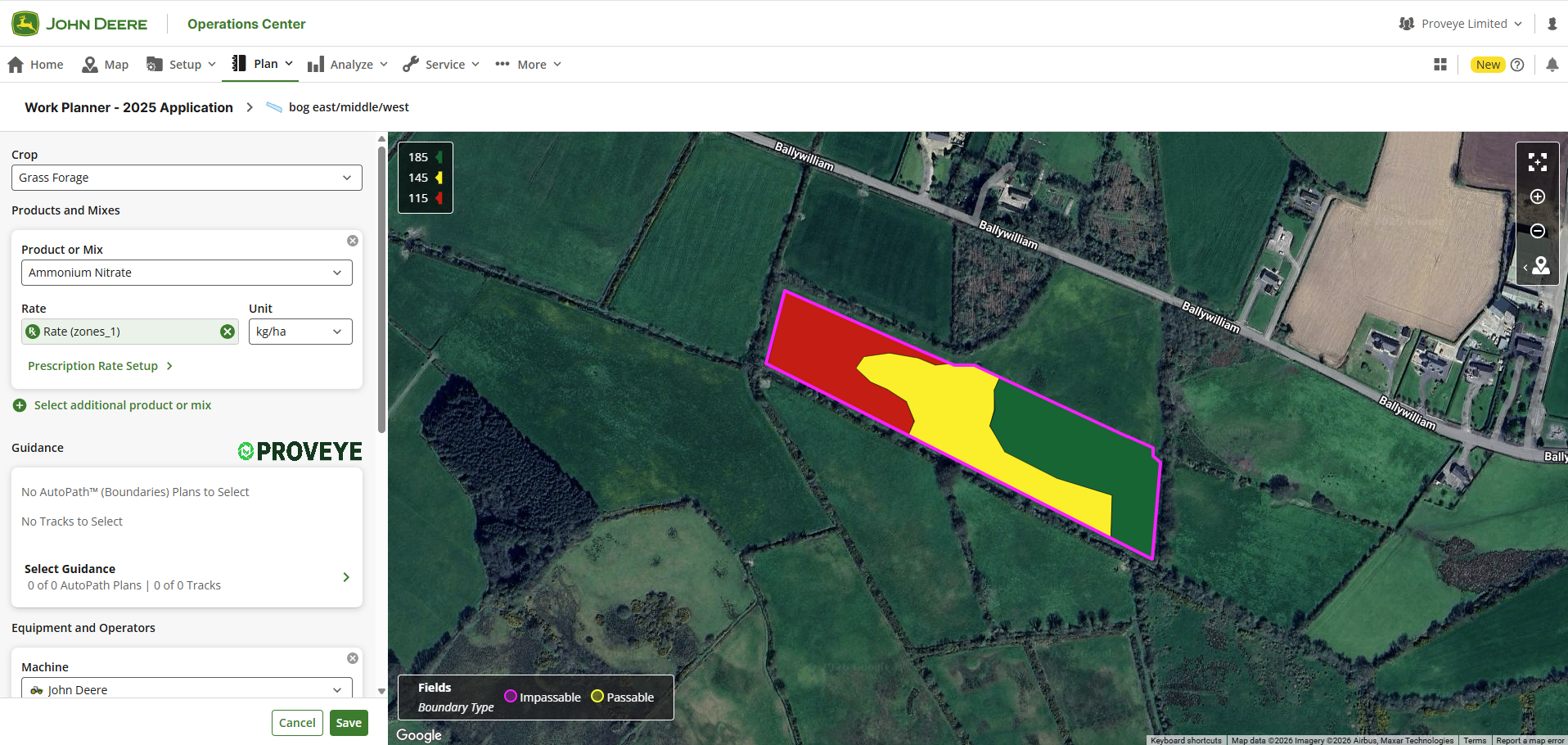
Example of a ProvVari variable rate application map from Proveye, being used in the John Deere Operations Centre ™ platform
What does that mean in the field?
In practical terms, this changes how fertiliser decisions are made.
Instead of asking: “How much fertiliser should I spread?”
The better question becomes: “Where will fertiliser deliver the greatest return?”
That shift allows farmers to:
The impact is measurable.
Prescriptive variable rate application of fertiliser in grassland can reduce the amount of spread fertiliser by 20–30%, while maintaining, and in many cases improving, overall performance.
Just as importantly, it creates a clear, traceable record of fertiliser application — something that is becoming increasingly valuable across the supply chain.
Unlocking the Value Already on Farms
There’s also a wider system impact.
ProvVari from Proveye sits at the intersection of these needs — not as a new way of farming, but as a way of making existing systems work significantly better.
In conclusion:
The current energy crisis has exposed something important: Input costs can no longer be taken for granted. Fertiliser is no longer just something you apply — it’s something you manage carefully, strategically, and increasingly, transparently.
The farms that navigate this period best won’t necessarily be the ones using the most inputs. They’ll be the ones using them most effectively. Because when margins are tight, regulations are evolving, and expectations are rising, precision isn’t a luxury.
It’s a necessity.
#ClimateTech #AI #ESG #RemoteSensing #grassland #pasture #teagasc #irish grassland


Digital measurement, monitoring and reporting of performance and risk alerts for nature-based solutions and regenerative agriculture.

Continuous remote measurement and predictive insights for grass-based food production systems for increased productivity and sustainability

An advanced photogrammetry solution for any industry that relies on precision mapping, 3D modelling and measurement from large image data sets.

